
Georg's Little Music Library
Music for Cello Solo (click here)
Music for Viola da Gamba (click here)
Music for Cello Duo / 2 Cellos (click here)
Cello & Guitar Duos (click here)
Violin (Recorder/Flute) & Cello (Duos) (click here)
Violin (or Flute) & Guitar (Duos) (click here)
Guitar Solos & Duos (click here)
CLASSICAL GUITAR METHOD (free & easy)
plus FREE TAB's
: * Online Guitar Course
: "Classical Guitar for Everyone"
: - Ancient to Romantic guitar music
: - Lessons with music in Notes & Tab attached
: Click here and Go to Collections for an overview!
My CELLO METHOD (formerly "Georg's Cello Method")
From Twinkle, twinkle little Star to Haydn Cello Concerto!
- enjoyable
- step by step guide, avoiding hurdles
- all cello duos
* Every piece comes with a link to:
- a corresponding online video lesson on patreon
- a cello duo recording on youtube (links interactive on tablet, phone, computer)
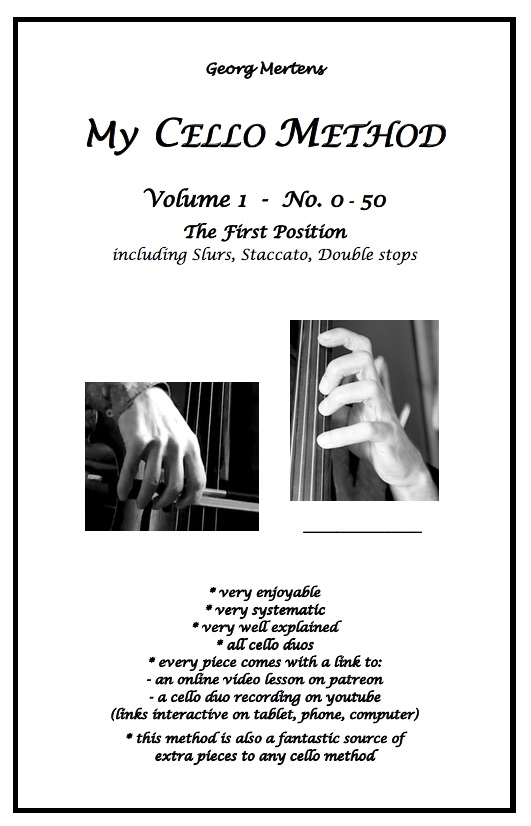
(The sheet music of the trial Section No 1-10 is a free attachment on the videos of No 1-10, click here)
- The Extensions in 1st Position - b & # - very clear step by step (click here)
- Learning systematically half , 2nd, 3rd & 4th Position (click here)
- Gems from the vast repertoire of music within Positions 1 - 4 (click here)
- Learning & Mastering Positions 5 - 7 (click here)
- Comfort withTreble clef & Thumb Position (click here)
Also: Online private Lessons (bottom of page)
Copyright by Georg Mertens, Katoomba Australia
forwarding, copying, selling, publishing without written permission is against the law.
All my Editions are written by hand.
Why?
Computer music programs have their own mind.
If you want to write fingerings in, they don't allow you to put it in the best place.
Also in new digital editions are so many mistakes, because things are done too fast.
I made the decision after I found 16 mistakes on 1 page in a new edition from a very reputed publisher.
When you write by hand and imagine in your head the melody you notice every note.
Online lessons via fb messenger, facetime or zoom
- please arrange a possible mutual time beforehand
on fb messenger: georg.mertens.96 or email: georgcello1@gmail.com
- multiple lessons can be booked
45 min USD $75
Cello Solos
Difficulty is marked in degrees from 1-10. Examples
- 1 = very easy, all first position
- 4 = (Breval sonata), position 1-4
- 6 = (Bach Prelude 1 or "The Swan")
- 9 = difficult (Haydn, Boccherini concertos)
- 10 = very difficult (Dvorak concerto)
Albeniz, Isaac - Asturias [Leyenda]
Arranged for cello solo.
Originally for piano, famous for guitar.
I have performed this piece for 30 years on guitar, but found particularly the middle part sounds great on cello.
Transcribed by Georg Mertens - [grading 9-10 out of 10]
Asturias Sheet music $5.00 (will be send per email during the next 24 hours)
An almost forgotten Renaissance Song of a rare beauty and simplicity.
The words show that the author was a woman, origin unknown.
Ich armes Maidlein - The score comes with a print of the last publication in 1926, words in German and English, cello solo with guitar accompaniment.
Sheet music $3.00 (will be sent per email during the next 24 hours)
or instantly available from SMP (click icon)
arr. for cello solo
Originally for lute, this piece gives the feeling of playing a viola da gamba.
Transcribed for cello solo
[grading 8 out of 10]
Melancholy Galliard Sheet music $3.00 (will be send per email during the next 24 hours)
or instantly available from SMP (click icon)for cello solo
[grading 5 out of 10]
Summertime Sheet music $3.00 (will be send per email during the next 24 hours)
Cadenza's in the style of Haydn's time.
[grading 9 out of 10]
Haydn Cadenzas Sheet music $4.50 (will be send per email during the next 24 hours)
or instantly available from SMP (click icon)
Arrangement for cello solo by Georg Mertens.
For 300 years (c1400-1700) the "diploma" for a viola da gamba player was to perform Variations on "La Folia", either own improvisations or someone else's composition. I chose a selection of variations by Marais, varied - or better said: extended - to suit an unaccompanied performance. I also added a few own variations. For years this theme has stimulated me humming and playing away!
[grading 9 out of 10]
Sheet music of "La Folia" $5.00 (will be send per email during the next 24 hours)
or instantly available from SMP / myscore (click icon) Arrangement for cello solo by Georg Mertens - matches violin/piano accompaniment part.
[grading 9 out of 10] revised Jan. '14
Meditation from Thais Sheet music $3.00 (will be send per email during the next 24 hours)
or instantly available from SMP / myscore (click icon) Several students complained to me that they started learning the cello, because they love the sound of the lower strings, but then once they advance most of the cello music is written mostly for A and D strings!
I promised to write music for the lower strings.
[grading 4 - 7 out of 10]
* Set of The 5 Preludes for the Love of the Lower Strings.
Sheet music (includes also the Old prelude No 1) $8.50
(will be send per email during the next 24 hours)
Prelude No 1 in D minor - "Sea Waves" - Evolving from one note to an arpeggio thunder (grading 4 out of 10)
Prelude No 2 in A minor - The Sound of Monks (grading 4-5 out of 10)
Written in 7 little chapters, the steps of the Aeolian scale - our alphabet from A - G, the base for the names of our notes. Each step is written in the mode based on the note it begins with: Aeolian, Locrian, Ionian, Dorian, Phrygian, Lydian, Mixolydian (and again Aeolian).
Prelude No 3 in C minor - "The Mellow Cello" written for the true love of the lower strings! (grading 5-6 out of 10)
Prelude No 4 in G minor - "Oriental" Haunting oriental melodies in harmonic minor accompanied with an open string drone. (grading 6 out of 10)
Prelude No 5 in C major - "The Harmonics Jester" - Fun with natural Harmonics (grading 7 out of 10)
Impressions of the Blue Mountains Rainforest.
Composed for and inspired by the "Rainforest Recitals" at the "Rainforest Hut", part of "Scenic World", Katoomba in January & February 2014.
( I ) Flowers, Shapes, Colours & Cicadas.
[grading 9 out of 10]
( II ) Tall trees; The Songs of the Birds
[grading 8 out of 10]
( III )Mist, Rain, Thunder, Sunshine breaking through
[grading 9 out of 10]
A Chaconne exploring in the variations the different sounds and effects in the Cathedral Chamber of Jenolan Caves.
for solo cello. This composition sounds particularly effective in churches.
(grading 9 out of 10)
Jenolan Ciaconna Sheet music $6.00
(will be send per email during the next 24 hours)
[Grading 4 out of 10]
Sheetmusic for Old Prelude No 1: $3.00
(will be send per email during the next 24 hours)
Inspired by the Anonymous 19th century guitar version, also known from the movie "Jeux Inderdit" [grading 9 out of 10]
Spanish Romance Sheet music $4.00
(will be send per email during the next 24 hours)
This piece uses guitar techniques like pizzicato tremolo and rasguado on the cello.
Very effective, fun, but very hard for left and right hand.
[grading 10 out of 10]
Tango Celloguitar Sheet music $7.00
(will be send per email during the next 24 hours)
The Variations are based on the original 6 note scale: ACDEFG
(medieval Minne song)
for solo cello [grading 8 out of 10]
Variations on Maytime Sheet music $3.00
(will be send per email during the next 24 hours)
[Theme: Traditional Japanese] for cello solo
[grading 7 out of 10]
Variations on Sakura, Sakura Sheet music $3.00
(will be send per email during the next 24 hours)
Originally piano, arrangement for 1 or 2 cellos by Georg Mertens (see also a version for violin & cello)
The solo part is the same as cello 1 for Duo.
[grading 3-4 out of 10]
Sheet music $3.00 (will be send per email during the next 24 hours)
or instantly available from SMP (click icon).originally guitar, arrangement for cello solo by Georg Mertens
(grading 8 out of 10)
Cantico Sheet music $3.00 (will be send per email during the next 24 hours)
Original guitar part unchanged.
Sheet music of cello & violin parts to Tarrega's Recuerdos del Alhambra $3.00
(will be send per emai during the next 24 hours)
or instantly available from SMP (click icon)I wrote for the first movement examples of typical Baroque ornaments down. Usually they are played in the repeats.
[grading 7 out of 10]
This Largo with ornamentation is also part of the edition of the whole Sonata for cello & guitar
plus
Sonata No 5 E minor, Largo 3rd mov. as Solo version (playing melody and continuo on one cello). In this version the solo cello plays the melody plus the original accompaniment in double stops.
(grading 8 out of 10)
Sheet music of both above movements $4.00 (will be send per email during the next 24 hours)
Viola da Gamba
Most pieces for viola da gamba are either just parts of an ensemble or a very difficult solo part showing off skills.
I chose here 3 pieces - originally for lute - which are solo pieces of exquisite musical value and not hard to play.
Published in TAB, alto and bass clefs: the player can choose their easiest method of learning.
The 3 pieces are:
"Bianco Fiore" by Cesare Negri (1535 - 1605) Renaissance
"Gavota" by Giuseppe A. Brescianello (1690 - 1758) Italian Baroque
"Prelude D minor" by Robert de Visee (1650 - 1725) French Baroque
Sheet music $5.50 (will be send per email during the next 24 hours)
or instantly available from SMP (click icon)
Harpsichord continuo arranged for guitar.
Guitar part only.
The guitar accompaniment matches the original cello part)
This Sonata is - literally taken - a Trio Sonata, written in a 3 part form: the right hand of the harpsichord, the Viola da Gamba and the continuo of the left hand of the harpsichord. The Viola da Gamba does not - as one would expect - play the leading role. Rather it is placed in the middle (like a viola) in between the right and left hand of the harpsichord.
- This set up might even suggest, it might as well have been meant for example for violin, a Viola da gamba and cello, the harpsichord playing the figured bass of the cello and in the form today as well the violin part.
In the arrangement here I found it more important to keep the top melody part complete ("the violin") or right hand of the harpsichord rather than the left hand.
I therefore fitted in the bass part as much as playable, leaving out mainly transitional notes and ornaments in the bass.
Surprisingly this lead to an accompaniment, which sounds rhythmically clearer and also forms in its part its own musical independence and sounds virtually like a complete guitar piece by being played just by itself.
Bach: Sonata for Viola da gamba D major, Adagio, Allegro, Andante
Sheet music of the guitar accompaniment $5.00 (will be send per email during the next 24 hours)
Click here for my Online Cello Course on Patreon -
Then go for Video Lessons to "Collections" / for sheet music to "Shop"
Music for 2 or 3 Cellos
Compositions and Arrangements by Georg Mertens
Difficulty is marked in degrees from 1-10. Examples
- 1 = very easy, all first position
- 4 = (Breval sonata), position 1-4
- 6 = (Bach Prelude 1 or "The Swan")
- 9 = difficult (Haydn, Boccherini concertos)
- 10 = very difficult (Dvorak concerto)
Schumann: Melody, and Brahms: Lullaby
I transcribed these two gentle melodies on request of my lovely student Kate for the enjoyment of putting her newly arrived grandchild Mia to bed.
I chose key and difficulty to the comfort of Kate and believe it will be the comfort zone of many students who have learned positions 1 to 4.
[grading 3-4 out of 10]
Arr. by Georg Mertens. Sheet music $4.00 (will be send per email during the next 24 hours)
The arrangements are opening up the Renaissance period to cellists, who are
by fate of history normally excluded from enjoying this wonderful music.
[grading: cello 3-7 out of 10 ]
Sheet music $9.00 (will be send per email during the next 24 hours)
This arrangement was a request by a student and is kept mainly in positions 1 - 4, with sometimes 5th position and one spot of 6th position.
The particular student learned 5, 6th position by playing this arrangement!
Written as Duo score $5.00 (will be send per email within 24 hours)
For 2 Cellos in C major and G major
[grading: cello 1: 7 out of 10 in C major]
[5 out of 10 in G - cello continuo: 2 out of 10 ]
Sheet music of both versions for 2 cellos $4.00 (will be send per email during the next 24 hours)
[grading 1 to 4 out of 10]
So many students asked me for more Chorals by Bach. Here are a few:
1st position, no extension in melody part
1 Nun ruhen all Waelder
1st position with extensions
2 Christus der uns selig macht
3 Wer nur den lieben Gott laesst walten
4 O Haupt voll Blut umwunden
5 Wachet auf ruft uns die Stimme, Bb maj
up to second position
6 Freue dich oh meine Seele
7 An Wasserfluessen
up to 4th position
5a Wachet auf ruft uns die Stimme, original key Eb maj
8 Jesu meine Freude ( for Duo or cello quartet)
Sheet music of 8 chorals together $7.00
(will be send per email during the next 24 hours)
or instantly available from SMP (click icon)
[grading 2 to 5 out of 10]
We played them at a wedding and everyone commented how beautiful they were!
1 Menuet C major (Petzold) BWV Anh. 116 (orig. G major)
2 Menuet C major (Petzold) BWV Anh. 114 (orig. G major)
3 Menuet D minor (Petzold) BWV Anh. 115 (orig. G minor)
4 Menuet D minor BWV Anh. 132
5 Menuet C minor BWV Anh. 121
6 Menuet A minor BWV Anh. 120
7 Menuet G major (probably Petzold) BWV XI.III.No IX
8 Menuet B minor from Orchestral Suite No 2
8b Menuet A minor from Orchestral Suite No 2 (orig. B minor)
Sheet music of 8 Menuets together $9.00 (will be send per email during the next 24 hours)
[grading: cello 1: 6 out of 10 / cello continuo 2-3 out of 10 ]
Sheet music of 2 cello parts plus guitar part. $4.00
(will be send per email during the next 24 hours)
Absolutely fabulous on two Cellos - maybe the most exciting cello Duo of the baroque period!
Playing the lute - or guitar - is like playing a Duo between the fingers and the thumb, exactly in the range of the cello.
The natural limitation of difficulty limits the composer to write it transparent - again ideal for 2 cellos.
The Lute Suite 1 is a traditional French Suite similar to the Cello Suites.
Suite complete:
Prelude (adagio/presto) - Allemande - Courante - Sarabande - Bourree - Gigue
Sheet music $8.00 (will be send per email during the next 24 hours)
or instantly available from SMP (click icon)
SINGLE MOVEMENTS:
Cello parts for sheet music of Sarabande & Bourree $4.50
(will be send per email during the next 24 hours)
arranged for 2 cellos by Georg Mertens
Original key - sounds amazingly authentic!
arrangement for 2 cellos
by Georg Mertens
Sheet music $3.00 (will be send per email during the next 24 hours)
* See also this Corelli Sonata transcribed for cello or violin & guitar
(originally for violin and harpsichord)
From 12 Sonatas for violin and cello or harpsichord.
Original key, matching the original violin part
Published in Rome on the 1st of January 1700 - start of the century!
Movements : Preludio - Allemande - Sarabande - Gigue,
and in brackets: Largo - Allegro - Largo - Allegro,
marking the name change in the new century with the switch from Dance names to tempo indications.
My favourite Corelli Sonata!
Sheet music includes solo cello, cello continuo and guitar continuo
plus violin & cello Duo, facsimile of J. Joachim's edition (1888) with added bowing & ornament suggestions
$8.00 (will be send per email)
Beautiful set of Renaissance variations.
Sheet music includes also the tune itself. which seems taken for granted in Cutting's score $4.00 (will be send per email)
[grading 8 out of 10]
Great theme and selected variations, brilliant finale!
Originally Classical guitar
(from Orfeo e Euridice)
for 2 cellos & guitar
[grading 6-7 out of 10]
The Melody is one of the most beautiful melodies written. After all, it persuaded the guards of the Underworld to let Orfeo in to see Euridice.
- Transcribed for cello & guitar with 2nd cello. Interestingly the 2nd cello hardly ever shares the same note with the solo cello, so just the 2 cellos create already an orchestral impression.
for 2 cellos
[grading 8 out of 10]
Exceptionally beautiful!
Originally Orchestral intermezzo from the opera "Goyescas"
Sheet music $6.00 (will be send per email during the next 24 hours)
for 2 cellos, cello & guitar, violin & guitar or violin & cello
[grading: cello 5-6 out of 10]
A dance with plenty of tempo and mood changes, very lively and entertaining.
Violin & guitar score part plus score for 2 cellos - 12 pages
Sheet music $5.00 (will be send per email during the next 24 hours)
or instantly available from SMP (click icon).
(Aria de Almirena: Lascia ch'io pianga (Let me weep)
Cello - with 2nd cello & accompaniment plus guitar accompaniment
[grading: cello 4 out of 10 / cello continuo 1-2 out of 10 ]
Sheet music of melody / cello acc. / guitar acc. $4.00
(will be send per email during the next 24 hours)
or instantly available from SMP (click icon)
(violin (recorder / oboe / shakuhachi) / cello & guitar acc.).
[grading 4 out of 10]
Sheet music of melody in treble and bass / cello acc. / guitar acc. $4.00
(will be send per email during the next 24 hours)
Arr. for 2 (3) cellos
[grading 4-5 out of 10]
Sheet music $3.00 (will be send per email during the next 24 hours)
2 cellos [grading 6 out of 10]
Sheet music $4.00 (will be send per email during the next 24 hours)
Gaspar Sanz - Pavanas (1674)
Exceptionally beautiful on 2 cellos!
originally guitar, this arrangement for cello Duo by Georg Mertens [grading 7 out of 10]
Gaspar Sanz - Canarios (1674)
Very lively exciting dance, lots of character and bounce.
originally guitar, this arrangement for cello Duo by Georg Mertens [grading 8 out of 10]
Gaspar Sanz (1674) - Pavanas & Canarios together
Duo Sheet music $6.00 (will be send per email during the next 24 hours)
or instantly available from SMP (click icon)
originally piano, arrangement for 1 or 2 cellos by Georg Mertens
[grading 3-4 out of 10]
(see also the version for violin& cello)
Duo Sheet music $4.00 (will be send per email during the next 24 hours)
originally harpsichord, arrangement for 2 cellos
plus arrangement for violin / recorder / flute / shakuhachi with cello
by Georg Mertens
Duo Sheet music $4.00 (will be send per email during the next 24 hours)
arr. for 2 Cellos
Cello parts Sheet music $4.00 (will be send per email during the next 24 hours)
Gorgeous and not hard!
Composed in 1686, this is the oldest known original instrumental Duo for the violin family.
Visee wrote the Suite for guitar but published in his "Livre de Guitare" the Suite also for violin and cello, either to be played as Duo or added to the guitar.
The original key is D minor, transcribed for 2 cellos to G minor.
The Suite includes the movements:
Prelude - Allemande - Courante - Sarabande - 2 Menuets - Bourree - Gavotte - Gigue
Sheet music $8.00 (will be send per email during the next 24 hours)
or instantly available from SMP (click icon)
Cello & Guitar Duos
Additional cello / violin parts by G. Mertens
- the original guitar part may be played unchanged.
- here is also added an alternate more rhythmical major part plus intro and a transition in to the Da capo. The players may decide to play tremolo in the D.C. and also make up an introduction, a transition and an ending to their own taste .
Sheetmusic of guitar, cello & violin parts to Spanish Romance $3.00 (will be sent per email during the next 24 hours)
or instantly available from SMP (click icon)- guitar part of part 1 unchanged, part 2 rhythm modified, same chords.
The players may decide to play tremolo in the D.C. and also make up an introduction, a transition and an ending to their own taste according to the feeling in the room (as we did).
Sheet music of cello & violin parts to Spanish Romance $4.50.
Includes guitar part and optional Intro / transition.
(will be sent per email during the next 24 hours)
Collection Forster 1549
An almost forgotten Renaissance Song of a rare beauty and simplicity.
The words show that the author was a woman, origin unknown.
Ich armes Maidlein - The score comes with a print of the last publication 1926, words in German and English, cello solo and guitar accompaniment. Sheet music $3.00 (will be send per email during the next 24 hours)
or instantly available from SMP (click icon)Additional cello / violin parts by G. Mertens
- the original guitar part may be played unchanged.
- here is also added an alternate more rhythmical major part plus intro and a transition in to the Da capo. The players may decide to play tremolo in the D.C. and also make up an introduction, a transition and an ending to their own taste .
Sheet music of 2 cello parts plus guitar part. $4.00 (will be sent per email during the next 24 hours)
or instantly available from SMP (click icon)
Harpsichord continuo arranged for guitar. Guitar part only
The guitar accompaniment matches the original cello part)
This Sonata is - literally taken - a Trio Sonata, written in a 3 part form: the right hand of the harpsichord, the Viola da Gamba and the continuo of the left hand of the harpsichord. The Viola da Gamba does not - as one would expect - play the leading role. Rather it is placed in the middle (like a viola) in between the right and left hand of the harpsichord.
This set up might even suggest, that the known edition might as well have been meant for example for violin, a Viola da gamba and cello, the harpsichord playing the figured bass of the cello and in the form today as well the violin part.
In the arrangement here I found it more important to keep the top melody part complete ("the violin") or right hand of the harpsichord rather than the left hand. I therefore fitted in the bass part as much as playable, leaving out mainly transitional notes and ornaments in the bass.
Surprisingly this lead to an accompaniment, which sounds rhythmically clearer and also forms in its part its own musical independence and sounds virtually like a complete guitar piece by being played just by itself.
Sheet music of 2 cello parts plus guitar part. $4.00 (will be sent per email during the next 24 hours)
for cello & guitar (originally in C minor for mandolin & harpsichord)
The guitar is naturally very close in sound to the harpsichord. The combination of cello and guitar sounds here absolutely wonderful - as if originally intended.
- There exist an edition for cello & piano by Stutschewsky (1931). However, Stutschewsky changed the tempo from Adagio to Andante and lifted the tempo in the major part even to "Un poco animato". Contrary to this suggestion the original Adagio sounds much more effective.
Stutschevsky changed also in the accompaniment the relationship between the solo instrument and the accompaniment and swapped parts around.
The edition here goes back to the Beethoven original.
Sheet music of 2 cello parts plus guitar part. $4.00 (will be sent per email during the next 24 hours)
or instantly available from SMP (click icon)These are - in my opinion - the most suitable and beautiful Duos originally written for cello & guitar, with a full understanding for both instruments by the composer.
Also these Duos are relatively easy to play, but on the other hand ready for the concert hall, very enjoyable.
In most editions the cello part is in tenor clef. The edition here by Charles Tourville published by Joseph Williams in 1921 is the only one I know of in bass clef.
Also his recommendations for the interpretation are fantastic.
(I changed the bowings a bit and added a few fingerings)
* The guitar part is from Petrucci's Public Domain Library.
In all guitar parts of Nocturne 1 the DOUBLE BAR line going to A major is set one bar different in the cello & guitar parts, so be careful!
If you say, let's go back to the double bar - that are two different double bars for each player! In the cello part it is the start of bar 21, in the guitar part start of bar 22 (same later).
(grading 4 out of 10)
(originally voice & orchestra/organ)
Original key. Literal arrangement.
(grading 6 out of 10)
Sheet music of Caccini $3.00 (will be send per email during the next 24 hours)
or instantly available from SMP (click icon)This movement is the only chamber music ensemble work by Chopin, which could be transcribed for cello & guitar, in fact it is very suitable.
The unusual key of Bb major by a composer indulging in complex harmonies gives the guitarist a new feeling of possible combinations.
Cello & Guitar parts [cello grading 7 out of 10 / guitar 8 out of 10]
Sheet music includes Chopin the old hand written part and the guitar part $4.00 (will be send per email during the next 24 hours)
or instantly available from SMP (click icon)for cello / violin and cello continuo / guitar
(originally for violin and harpsichord)
From 12 Sonatas for violin and cello or harpsichord.
Original key, matching the original violin part
Published in Rome on the 1st of January 1700 - start of the century!
Movements : Preludio - Allemande - Sarabande - Gigue,
and in brackets: Largo - Allegro - Largo - Allegro, marking the name change in the new century.
(My favourite Corelli Sonata)
Sheet music includes solo cello, cello continuo and guitar continuo plus violin & cello Duo, facsimile of J.Joachim's edition (1888) with added bowing & ornament suggestions $8.00 (will be send per email)
or instantly available from SMP (click icon)One of the most stunning Sarabande's ever written.
Sheet music includes solo cello, cello continuo and guitar continuo plus violin & cello Duo, facsimile of J.Joachim's edition (1888) with added bowing & ornament suggestions $8.00 (will be send per email)
* See also this Corelli Sonata transcribed for 2 cellos or violin/cello Duoarranged for cello and guitar by Georg Mertens.
[cello grading 5 out of 10 & guitar grading 6 ]
Sheet music for Cello & Guitar $4.00 (will be send per email during the next 24 hours)
or instantly available from SMP (click icon)arranged for cello or violin and guitar by Georg Mertens.
Belonging to the cello repertoire since Pablo Casals transcription in 1911. Here the arrangement for cello & guitar.
[cello& guitar grading 7 out of 10 ]
Sheet music for Cello & Guitar $4.00 (will be send per email during the next 24 hours)
or instantly available from SMP (click icon)arranged for cello or violin and guitar by Georg Mertens.
Although a Russian traditional, this tune became famous sung by the Welsh folk singer Mary Hopkin in 1967.
Sheet music of Violin or cello & Guitar $4.00 (will be send per email during the next 24 hours)
or instantly available from SMP (click icon)for cello & guitar (2 cellos)
[grading 6-7 out of 10]
The Melody is one of the most beautiful melodies written. After all, it persuaded the guards of the Underworld to let Orfeo in to see Euridice.
Transcribed for cello & guitar with 2nd cello.
Sheet music of $5.00 (will be send per email during the next 24 hours)
or instantly available from SMP (click icon)cellos & guitar
[grading 6-7 out of 10]
The Melody is one of the most haunting and beautiful melodies written.
Bowings according to the original phrasing on piano.
Medium level, with fingerings for both instruments.
Sheet music of $5.00 (will be send per email during the next 24 hours)
or instantly available from SMP (click icon)
arranged for cello/violin & guitar
[grading 6 out of 10]
Sheet music of "The Old Gypsy" $5.00 (will be send per email during the next 24 hours)
or instantly available from SMP (click icon)
for Cello / Violin & Guitar
1 - Deep Sorrow (Hungarian)
2 - Lento from "Zigeunerweisen / Gypsy Airs (Pablo de Sarasate)
3 - Hundred Kisses (Hungarian)
Cello / Violin & guitar Duo parts.
13 pages [grading: cello 6-7 out of 10 ]
Sheet music of $7.00 (will be send per email during the next 24 hours)
or instantly available from SMP (click icon)
for cello & guitar, violin & guitar or 2 cellos or violin & cello
A dance with plenty of tempo and mood changes, very lively and entertaining.
Violin & guitar score part plus score for 2 cellos
12 pages [grading: cello 5-6 out of 10]
Sheet music $5.00 (will be send per email during the next 24 hours)
or instantly available from SMP (click icon)
Aria de Almirena: Lascia ch'io pianga (Let me weep)
Cello with 2nd cello & guitar accompaniment
[grading: cello 4 out of 10 / cello continuo 1-2 out of 10 ]
Sheet music of melody / cello acc. / guitar acc. $4.00 (will be send per email during the next 24 hours)
or instantly available from SMP (click icon)
arr. for 2 cellos (violin (recorder / oboe / shakuhachi) / cello & guitar.).
[grading 4 out of 10]
Sheet music of melody in treble and bass / cello acc. / guitar acc. $4.00 (will be send per email during the next 24 hours)

arr. for cello & guitar (originally violin & guitar)
Original key
[cello part grading 8 out of 10 / guitar part c 5 out of 10]
Sheet music cello & guitar parts $5.00 (will be send per email during the next 24 hours)
arranged for cello and guitar by Georg Mertens (E major).
[cello grading 6 out of 10 / guitar grading 7 out of 10]
Sheet music for Cello & Guitar $4.00 (will be send per email during the next 24 hours)
or instantly available from SMP (click icon)
arranged by Georg Mertens
Violin or cello & guitar
[grading 6 out of 10]
Sheet music for La Cumparsita violin / cello & guitar parts $6.00 (will be send per email during the next 24 hours)
or instantly available from SMP (click icon)
arranged for cello and guitar by Georg Mertens.
[cello grading 5 out of 10 / guitar grading 7 out of 10]
Sheet music for Cello & Guitar $4.00 (will be send per email during the next 24 hours)
arranged for cello and guitar by Georg Mertens.
[cello grading 6 out of 10 / guitar grading 7 out of 10]
Sheet music for Cello & Guitar $4.00 (will be send per email during the next 24 hours)
or instantly available from SMP (click icon)
additional cello / violin parts by G. Mertens
- original guitar part unchanged.
Sheet music of cello & violin parts Tarrega's Recuerdos del Alhambra & $3.00 (will be send per email during the next 24 hours)
Arranged for cello & guitar by Georg Mertens
1 - Sicilienne by Maria-Theresia von Paradis (in E major)
2 - Apres un Reve by Gabriel Faure (in C minor)
3 - Ave Maria by Franz Schubert (in A major)
[grading cello 5-7 out of 10 / guitar 7 out of 10]
Sheetmusic of cello & guitar parts $8.99 (will be send per email during the next 24 hours)
(see below for the editions of the single pieces)
or instantly available from SMP (click icon)
arranged for cello or violin (flute / recorder / shakuhachi) & guitar
[grading 6 out of 10]
Sheet music for El Condor Pasa $4.00 (will be send per email during the next 24 hours)
or instantly available from SMP (click icon)arranged for cello or violin (flute / recorder / shakuhachi) & guitar
[grading 6 out of 10]
Sheet music for the SONG OF THE BIRDS $4.00 (will be send per email during the next 24 hours)
or instantly available from SMP (click icon)arranged by Georg Mertens as performed by the Paganini Duo
Violin (or cello) & guitar [grading 7 out of 10]
Sheet music for "Black Eyes" violin & guitar parts $4.00 (will be send per email during the next 24 hours)
or instantly available from SMP (click icon)
arr. for cello & guitar.
This edition includes
(1) A facsimile of the first print (1740) which is cello 1 plus cello continuo including the figured bass.
(2) 1st movement Largo including Baroque ornaments as in video
(3) guitar accompaniment to all movements.
(cello & guitar including Baroque ornamentation)
$ 7.99 (will be send per email during the next 24 hours)
or instantly available from SMP (click icon) Violin & Cello Duos
(also recorder, shakuhachi, oboe & cello)
for Violin & Cello [grading 1 to 4 out of 10]
plus "Jesu meine Freude" for string quartet
So many students asked me for more Chorales by Bach. Here are a few:
1 Nun ruhen all Waelder
2 Christus der uns selig macht
3 Wer nur den lieben Gott laesst walten
4 O Haupt voll Blut umwunden
5 Wachet auf ruft uns die Stimme, Bb maj
5a Wachet auf ruft uns die Stimme, original key Eb maj
6 Freue dich meine Seele
7 An Wasserfluessen
8 Jesu meine Freude ( for Duo or string quartet)
for Violin & Cello [grading 2 to 6 out of 10]
We played them at a wedding and everyone commented how beautiful they were!
1 Menuet G major (Petzold) BWV Anh. 116
2 Menuet G major (Petzold) BWV Anh. 114
3 Menuet G minor (Petzold) BWV Anh. 115
4 Menuet D minor BWV Anh. 132
5 Menuet C minor BWV Anh. 121
6 Menuet A minor BWV Anh. 120
7 Menuet G major (probably Petzold) BWV XI.III.No IX
8 Menuet B minor from Orchestral Suite No 2
8b Menuet A minor from Orchestral Suite No 2 (orig. B minor)
Sheet music of 8 Menuets together $9.00 (will be send per email during the next 24 hours)
or instantly available from SMP (click icon)
* See also this Corelli Sonata transcribed for cello or violin & guitar
for cello & guitar, violin & guitar or 2 cellos or violin & cello
A dance with plenty of tempo and mood changes, very lively and entertaining.
Violin & guitar score part plus score for 2 cellos
12 pages [grading: cello 5-6 out of 10]
Sheet music $5.00 (will be send per email during the next 24 hours)
or instantly available from SMP (click icon)
arr. for 2 cellos (violin (recorder / oboe / shakuhachi) / cello & guitar.).
[grading 4 out of 10]
Sheet music of melody in treble and bass / cello acc. / guitar acc. $4.00 (will be send per email during the next 24 hours)
Enter text here
Sheet music of "Pachelbel Canon - the not so boring cello part" $3.00 (will be send per email during the next 24 hours)
or instantly available from SMP (click icon)Violin & Cello Duo with Bach Prelude G major
Violin & cello [grading 6 out of 10]
Sheet music $5.00 (will be send per email during the next 24 hours)
originally piano, arrangement for violin & cello by Georg Mertens [grading 3 out of 10]
(see also the version for 2 cellos)
or instantly available from SMP (click icon)
originally harpsichord, arrangement for 2 cellos
plus arrangement for violin / recorder / flute / shakuhachi with cello
by Georg Mertens
Duo Sheet music $4.00 (will be send per email during the next 24 hours)
arr. for Violin & Cello
Violin & Cello parts Sheet music $4.00 (will be send per email during the next 24 hours)
or instantly available from SMP (click icon)
for violin & cello.
Gorgeous and not hard!
Composed in 1686, this is the oldest known original instrumental Duo for the violin family. Visee wrote the Suite for guitar but published in his "Livre de Guitare" the Suite also for violin and cello, either to be played in his words (in French) as Duo or added to the guitar.
Original key D minor
The Suite includes the movements: Prelude - Allemande - Courante - Sarabande - 2 Menuets - Bourree - Gavotte - Gigue
Sheet music $8.00 (will be send per email during the next 24 hours)
or instantly available from SMP (click icon)
Violin & Guitar Duos
- guitar part of part 1 unchanged, part 2 rhythm modified, same chords.
The players may decide to play tremolo in the D.C. and also make up an introduction, a transition and an ending to their own taste according to the feeling in the room (as we did).
Sheet music of cello & violin parts to Spanish Romance $4.50.
Includes guitar part and optional Intro / transition.
(will be sent per email during the next 24 hours)
for cello / violin and cello continuo / guitar
(originally for violin and harpsichord)
From 12 Sonatas for violin and cello or harpsichord.
Original key, matching the original violin part
Published in Rome on the 1st of January 1700 - start of the century!
Movements : Preludio - Allemande - Sarabande - Gigue,
and in brackets: Largo - Allegro - Largo - Allegro, marking the name change in the new century.
(My favourite Corelli Sonata)
Sheet music includes solo cello, cello continuo and guitar continuo plus violin & cello Duo, facsimile of J.Joachim's edition (1888) with added bowing & ornament suggestions $8.00 (will be send per email)
or instantly available from SMP (click icon) * See also this Corelli Sonata transcribed for cello or violin & guitar
arranged for cello or violin and guitar by Georg Mertens.
Although a Russian traditional, this tune became famous sung by the Welsh folk singer Mary Hopkin in 1967.
Sheet music of Violin or cello & Guitar $4.00 (will be send per email during the next 24 hours)
or instantly available from SMP (click icon)arranged for cello/violin & guitar
[grading 6 out of 10]
Sheet music of "The Old Gypsy" $5.00 (will be send per email during the next 24 hours)
or instantly available from SMP (click icon)
for Cello / Violin & Guitar
1 - Deep Sorrow (Hungarian)
2 - Lento from "Zigeunerweisen / Gypsy Airs (Pablo de Sarasate)
3 - Hundred Kisses (Hungarian)
Cello / Violin & guitar Duo parts.
13 pages [grading: cello 6-7 out of 10 ]
Sheet music of $7.00 (will be send per email during the next 24 hours)
or instantly available from SMP (click icon)
for cello & guitar, violin & guitar or 2 cellos or violin & cello
A dance with plenty of tempo and mood changes, very lively and entertaining.
Violin & guitar score part plus score for 2 cellos
12 pages [grading: cello 5-6 out of 10]
Sheet music $5.00 (will be send per email during the next 24 hours)
or instantly available from SMP (click icon)
including "Gypsy Adagio" Maros & Don Giorgio Mainerio's "Ungaresca" (c 1540 - 1580)
arr. for 2 cellos (violin (recorder / oboe / shakuhachi) / cello & guitar.).
[grading 4 out of 10]
Sheet music of melody in treble and bass / cello acc. / guitar acc. $4.00 (will be send per email during the next 24 hours)
arranged by Georg Mertens
Violin or cello & guitar
[grading 6 out of 10]
Sheet music for La Cumparsita violin / cello & guitar parts $6.00 (will be send per email during the next 24 hours)
or instantly available from SMP (click icon)
additional cello / violin parts by G. Mertens
- original guitar part unchanged.
Sheet music of cello & violin parts Tarrega's Recuerdos del Alhambra & $3.00 (will be send per email during the next 24 hours)
arranged for cello or violin (flute / recorder / shakuhachi) & guitar
[grading 6 out of 10]
Sheet music for El Condor Pasa $4.00 (will be send per email during the next 24 hours)
or instantly available from SMP (click icon)arranged by Georg Mertens as performed by the Paganini Duo
Violin (or cello) & guitar [grading 7 out of 10]
Sheet music for "Black Eyes" violin & guitar parts $4.00 (will be send per email during the next 24 hours)
or instantly available from SMP (click icon)
Guitar Solos & Duos
arranged for 2 guitars.
This Sonata is - literally taken - a Trio Sonata, written in a 3 part form: the right hand of the harpsichord ("violin"), the Viola da Gamba and the left hand of the harpsichord, the continuo.
The Viola da Gamba does not - as one would expect - play the leading role. Rather it is placed in the middle (like a viola) in between the right and left hand of the harpsichord.
In the arrangement here I found it important to keep the top melody part complete ("violin") rather than the left hand. I therefore fitted in the bass part as much as playable, leaving out some transitional notes and ornaments.
Surprisingly this lead to an accompaniment, which sounds rhythmically clearer.
* Bach: Sonata for Viola da gamba D major, Adagio & Allegro
Sheet music 2 guitar parts $8.00 (will be send per email during the next 24 hours)
arr. for 2 guitars (originally in C minor for mandolin & harpsichord)
In a sense both mandolin and harpsichord are a plucked instrument.
The guitar is naturally very close to both.
The oringinal combination is hardly being performed.
The guitar melody part can also be played by mandolin; I added stroke direction suggestions for mandolin (plectrum guitar).
The original tempo indication by Beethoven is ADAGIO, as taken here.
Sheetmusic for 2 guitars (mandolin and guitar) $4.00 (will be send per email during the next 24 hours)
or instantly available from SMP (click icon)
FIRST PRINTED MUSIC IN HISTORY, published by O. Petrucci in 1507
originally TAB for lute, arranged for lute / guitar (3rd string F# instead of G)
[grading c 6 out of 10]
originally piano, arranged for solo guitar.
[grading c 6 out of 10]
Sheet music $3.99 (will be send per email during the next 24 hours)
originally harpsichord, arranged for solo guitar.
[K 32 grading 5 out of 10, K208 7 out of 10]
arranged for 2 guitars incorporating the accompaniment of the string orchestra pizzicato.
[grading 5 out of 10]
Sheet music $4.00 (will be send per email during the next 24 hours)
Free Classical Guitar Method + Free TAB's
(For Now Free)
The Guitar Method is not finished and all parts are being reviewed (2018-2023
CONTENTS
No. TITLE
I Where are the Notes on the Guitar?
A - The open strings
B - The Notes in the standard first position
C - The Notes on all strings in all positions
D - Sharps (#) and flats (b)
II Finger indications of right and left hand
III Tuning the Guitar
IV Notation and names for the length of notes and rest
No I - IV from Classical Guitar Method (free)
1 The high E - string / Tica tica Tuc tuc
2 The Left hand / 4 -1 - open
3 Rain, rain, go away
4 Waves Melody
5 Open E and B strings
6 The Notes on the B-string
7 The Notes on the E and B strings
8 Happy Dance
9 Melody in C major (G.M.)
10 The G string
11 The open 3 top strings with a, m, i
12 Andantino (G.M.)
13 Ode to Joy (Beethoven)
14 Mountain Road (G.M.)
15 - The open Bass Strings D, A & E
16 Frere Jacques
16 - Sharps - here f#
17 Andantino (Carcassi)
18 - c#, g# & natural
19 E - Drive (G.M.)
20 Evening (G.M.)
21 - The general Notation for the Classical Guitar
22 Flamencino I (G.M.) - everyone's favourite!
23 B - Drive (G.M.) - triplets
24 The Clown (G.M.)
25 Melancholy (G.M.)
26 Blind Study - hitting the right string without looking (G.M.)
27 - The Notes on the Bass Strings
28 Andantino (Carcassi)
29 Scale in C major
30 Scale in A melodic minor
31 Moderato - Training i, m, a (G.M.)
32 Bass Note Reading
33 Flamencino II (G.M.)
34 Asturiana (G.M.)
35 Bass Study after Fernando Sor (G.M.)
36 Andante (Diabelli)
37 Poco allegretto (Carulli)
38 Scale in A major
39 Bright Sunshine (G.M.)
40 Tangillo (G.M.)
41 Exercise for Shifting Positions (G.M.)
42 Allegro (Aguado)
43 Synchronisation Study (G.M.)
44 Very useful Exercise to separate 3 & 4 (G.M.)
45 Valse (Carulli)
46 Concert Toccatina (G.M.)
47 Shifts used in the Toccatina
48 Outer Space Sounds - 12 Tone Style (G.M.)
49 Romance I (G.M.)
50 Study for changing in higher Positions (Coste/Mertens)
51 Romance II (Trad.)
52 Solo to Tangillo (No 40) (G.M.)
52T Solo to Tangillo (No 40 )in TAB (G.M.)
At this stage the progress of the Guitar method relies on DONATIONS (unit $5):
My Cello Method
from Twinkle, twinkle little Star to Haydn Cello Concerto!
- step by step, avoiding hurdles
- everything explained in detail
- cello duo parts throughout
* Every piece comes with a link to:
- an online video lesson on patreon
- a cello duo recording on youtube
- links interactive on tablet, phone, computer
My CELLO METHOD VOLUME 1 - A comfortable and enjoyable Beginning - 1st Position unextended (click here)

My CELLO METHOD Volume 2 - The Extensions in 1st Position - b & # - very clear (click here)
My CELLO METHOD Volume 3 - Learning systematically half, 2nd, 3rd & 4th Position (click here)
My CELLO METHOD Volume 4 - Gems from the vast repertoire of cello music within Positions 1 - 4 / Tenor clef (click here)
My CELLO METHOD Volume 5 - Learning & Mastering Positions 5 - 7 (click here)
My CELLO METHOD Volume 6 - Comfort in Treble clef & Thumb Position (click here)
* The Trial section of My CELLO METHOD (No 1-10) is attached for free on the (public) patreon video lessons
VOLUME 1 No. 0 - 50 : FIRST POSITION
* My CELLO METHOD includes links to video lessons which operate on tablet, phone or computer.
* NEW: all accompaniments are at the level of the melody
Advantage: Ensemble play starts at Lesson 1
Cello technique can be learned online
The ensemble coordinator does not need to be a cello teacher.
A -TIPS on how to make optimal use of My CELLO METHOD
B - How to Practice - Some useful Tips
C - Chart of Note Values
No 0 - Getting started
- The open strings / the reading concept / up & down bow.
No 1 - One, two, three, four, One - Learning to play in rhythm on open strings
- Includes 1/4 reading, counting & playing 4/4, rhythmical bow movement and feel / rests
No 2 - Minims or Half notes on open strings (1/2)
- Teaches to create a more continuous sound and a feeling for the bow /
bow treatment for the different strings.
No 3 - Rain, Rain go away [traditional English]
- Introducing the left hand, reading 2 notes without finger indication, stretch from1 - 4, pizzicato ; with 2nd cello already playable for students.
No 4 - Hot Cross Buns - for our young players
No 5 - 15 EASY READING IN THE KEY OF D MAJOR
No 5 - Open strings accompaniment to No 5, Twinkle, twinkle little Star
- The accompaniment has the same bowing as the song, preparing the use of the bow and left hand together.
No 6 - Twinkle, twinkle little Star
[melody: Traditional Austrian: "Morgen kommt der Weihnachtsmann"]
No 7 - French Folk Song [Traditional French] with 2nd cello for the teacher
- Starting V in order to have the finish notes in down bow
- Plus a little chapter on Counting
No 8 - Scale in D major - Warm up
- The scale has a rest between the notes to prepare the next finger - plus to teach not to lift the bow.
No 9 - Tica tica Tuc - tuc. Quavers/8th notes [Mertens] with 2nd cello for students
- Repetitive rhythmical pattern, fun for students, plus introducing the1st finger on G and C string.
Download FREE Trial Section Volume 1 of My CELLO METHOD No 0-9
My CELLO METHOD - VOLUME 1
- 1st Position
$ 12.99 (will be send per email during the next 24 hours)
or instantly available from SMP (click icon)
For corresponding video lessons on Patreon
Watch all Cello Duos to My CELLO METHOD (lower part of tracks)
No 10 - Frere Jacques / Where is Thumbkin [Traditional French]
- In Frere Jacques every bar is repeated; the repeated bar has no fingerings to learn focussing on note reading instead of finger reading.
No 11 - All my little Ducklings / Alle meine Entchen [Traditional German]
with 2nd cello for students
- All my little Ducklings is a song based on the major scale, in Germany the first song to learn
No 12 - Lightly Row / Haenschen klein [Traditional German] (corrects mistakes in the Suzuki version) with 2nd cello
No 13 - Ode to Joy / Freude schoener Goetterfunke [Beethoven] with easy 2nd cello for students
- recommended for memory play ; introduction of dotted rhythm.
No 14 - Fox Song / Song of the Wind / Fuchs du hast Gans gestohlen [Traditional German] with 2nd cello for students.
Corrects mistakes in the Suzuki version
- Rhythmical movement song / teaches to leave a finger on the old string for convenience and better intonation.
No 15 - The Bee baa Bootzelman / Der Bi Ba Butzelmann [Traditional German] with a fun pizzicato part for the teacher
For corresponding video lessons on Patreon
Watch all Cello Duos to My CELLO METHOD (forward to lower part of tracks)
No 16 - 21 THE KEY OF G MAJOR / 2nd FINGER
No 16 - The scale in G major with accompaniment
No 17 - The Notes in G major
No 18 - Andantino [Carcassi] - Introducing the 2nd finger / with cello accompaniment for the teacher
- Finally an instrumental piece, a joy to play! This little piece fixes often the problem of touching by mistake the wrong string.
No 19 - Silent Night / Heilige Nacht [Max Gruber] with 2nd cello for students
- This song has a wide range covering all notes from the C on the A string to the open G string.
No 20 - Happy Birthday [Traditional English] with 2nd cello for students
No 21 - Arpeggio Study [Mertens] with an accompaniment for students
(See No 23 for this Arpeggio study with slurred bowing)
For corresponding video lessons on Patreon
Watch all Cello Duos to My CELLO METHOD (forward to lower part of tracks)
No 22 - 27 SLURS
No 22 - a / b / c / d - Slur Exercises
- Learning slurs in string crossings and from note to note, gradual transition between strings.
No 23 - Arpeggio Slur Study: Like No 21, but with slurs
No 24 - Quick Tune [G. Mertens] 2 notes slurred
With 2nd cello for students
No 25 - Rigadoon [Purcell] for Accompaniment see No 44
- Favourite of students
No 26 - Nun ruhen alle Waelder [Bach]
- The tune is based on "Innsbruck ich muss dich lassen" by H.Isaac c. 1490 - one of Bach's favourite melodies.
No 27 - Intonation Study [Mertens]
- putting 1 & 4 exactly right
For corresponding video lessons on Patreon
Watch all Cello Duos to My CELLO METHOD (forward to lower part of tracks)
No 28 - 32 THE KEY OF C MAJOR
- No 33 - 35 Minor Keys
- No 36, 37 more advanced pieces in E minor & G major
- No 38, 39 more advanced pieces in C major
No 28 - Scale in C major with accompaniment
- with the accompaniment an ideal meditative starting piece
No 29 - Nimble Fingers [Mertens] 2nd cello in pizzicato for students
- Strictly always separated 8/8. The piece is based on the C scale. It is physically more fun and teaches the scale.
No 30 - Study in C major [Mertens] with 2nd cello for students
No 31 - The Volga Boatsmen Song (Russian Trad.)
No 32 - The Hippopotamus - [Mertens] cello solo
- A funny piece, portraits the character of the Hippo using the low register.
No 33 - Maienzeit / Maytime [Neidhardt] with 2nd cello for students
- written c. 1200, the oldest song I know. Beautiful melody in the Aeolian mode.
No 34 - Scarborough Fair [Traditional English] with 2nd cello for students
- Famous Renaissance song. Uneven bows, 2 beats down to 1 up, a challenge to sound control.
No 35 - Sakura, Sakura [Traditional Japanese]
- Famous Japanese song, very slow and full of character.
No 36 - Hatikvah [B. Smetana, also Traditional Jewish] with 2nd cello for students
- favourite of many students.
No 37 - The Ashgrove [Traditional English] for 2nd cello for students
- Cheerful old English tune with a dance like middle section.
No 38 - Study in C major after Fernando Sor / for 2nd cello for students see
- Originally for guitar, this study is like written for the cello, includes all notes from the open C string to the high C on A.
No 39 - Early one Morning [Traditional English] with 2nd cello for students
- a challenge for string crossings.
For corresponding video lessons on Patreon
Watch all Cello Duos to My CELLO METHOD (forward to lower part of tracks)
No 40 - 50 BOW VERSATILITY
No 40 - Staccato Exercise
No 41 - Double Stop Exercise
No 42 - Morning Stroll [Gretchaninov]
- Teaching 2 up bows in staccato with different character /
teaching to switch from pizz. to arco.
No 43 - We wish you a Merry Christmas with 2nd cello for students
No 44 - Rigadoon II [Purcell] Accompaniment to No 25
- The accompaniment is harder than the melody, a slower pace is recommended for learning.
No 45 - Legato Study in G major after Dotzauer / with 2nd cello for students
- 4 & 8 notes slurred ; great study for even bow movement.
No 46 - What shall we do with the Drunken Sailor / with 2nd cello for students - bow technique
No 47 - Hornpipe [Irish Fiddle Tune] with 2nd cello for students
- Well known fast Irish tune.
Teaches to keep the first finger on one string while moving to other strings / fast string crossings.
No 48 - String Crossing Study (GM)
- How to play fast and smooth string crossings and arpeggios
No 49 - Double stop and Staccato Exercises as Preparation for No 50 "Double-Double Stops"
No 50 - Double-Double Stops. Bouncy cello duo, both parts playing double stops. Effective performance piece.
My CELLO METHOD - VOLUME 1
- 1st Position
$ 12.99 (will be send per email during the next 24 hours)
or instantly available from SMP (click icon)
(for private online lessons see bottom of page)
My CELLO METHOD - VOLUME 2
- The Extensions
* My CELLO METHOD includes links to video lessons which operate on tablet, phone or computer.
$ 8.99 (will be send per email during the next 24 hours)
or instantly available from SMP (click icon)
COMPARISON of 1st Position and its Extensions
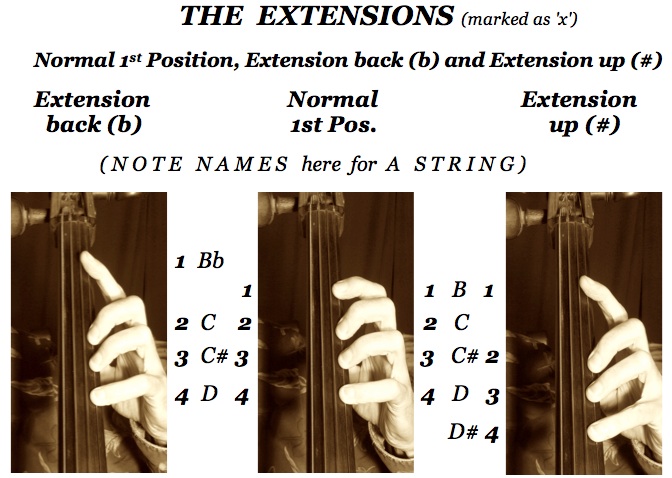
51 - 55 THE EXTENDED FIRST POSITION (BACK / b )
For corresponding video lessons on Patreon
Cello Duos to My CELLO METHOD - lower part of tracks
No 51a - Exercise for .the Extended Position back (b)
- Starting extensions with the extension back brings the hand naturally in the correct position for all extensions.
No 51 - Dona, Dona [Traditional Yiddish] with 2nd cello for students
No 52 - Choral: Christus der uns selig macht [Bach] with 2nd cello for the teacher
- This Choral is not only very beautiful, it also exercises extending from1 to 2 upwards in slow motion.
No 53 - Spagnoletto [Cesare Negri] with 2nd cello for students
- Bouncy Renaissance dance with fast extension play.
No 54 - Passamezzo [Phalese] with 2nd cello for students
- Ancient dance (1560) with an interesting striking harmony: G minor alternating with F major (Aeolian).
No 55 - Chorea. beautiful Renaissance Dance - with 2nd cello for students
For corresponding video lessons on Patreon
Cello Duos to My CELLO METHOD (lower part of tracks)
56 - 59 THE EXTENDED FIRST POSITION (UP /#)
No 59 - Minuet in C [Petzold / Bach]
(2nd cello for students see No 68
60 - 63 FIRST POSITION WITH BOTH EXTENSIONS
No 60 - Scale in D melodic minor
(for corresponding video lesson including a chapter on the structure and history of this scale)
No 61 - Gilderoy [Traditional Irish] with 2nd cello for students
a beautiful melodic tune in D minor.
No 62 - Danza [Chilesotti] with 2nd cello for students
- A very rhythmical, syncopated dance demonstrating the joyful rhythm of the Rennaissance
No 63 - Greensleeves [after Francis Cutting 1560] with 2nd cello for students.
- The original Greensleeves is written in the form of an Sicilienne, by contemporaries called: "An Italian Ground"
My CELLO METHOD - VOLUME 2
- The Extensions
$ 8.99 (will be send per email during the next 24 hours)
or instantly available from SMP (click icon)
My CELLO METHOD - VOLUME 3
- Half Position to 4th Position, Harmonics, Tuning & Vibrato -
My CELLO METHOD includes interactive links to video lessons
which operate on tablet, phone or computer.
$ 13.99 (will be send per email during the next 24 hours)
or instantly available from SMP (click icon)
64 - 68 - THE HALF POSITION
No 64 - Exercise for the Half Position including PHOTOS
No 65 - La Folia (15 Cent. Spanish) for 2 cellos
No 66 - Tis the last Rose of Summer [Thomas Moore] for 2 cellos
No 67 - Study in E minor by F. Dotzauer (for 2 cellos)
No 68 - Accompaniment to Minuet in C [Petzold / Bach, No 59]
For corresponding video lessons on Patreon
Cello Duos to My CELLO METHOD (lower part of tracks)
69 - 77 - THE SECOND POSITION
No 69 - Exercises for Second Position (not extended) including PHOTOS
No 70 - Two Accompaniments:
A - to No 18: M. Carcassi - Andantino
B - to No 26: J.S. Bach - Nun ruhen alle Waelder
No 71 - Cello Duo No 1 by J. Offenbach
No 72 Hungarian Dance [Book of Sopron] with 2nd cello for students
No 73 - Dominion [Irish Traditional] with 2nd cello for students
74 - 77 - THE SECOND POSITION EXTENDED
No 74 - Exercises for 2nd Position extended including PHOTOS
No 75 - The Old Reel [Traditional Irish] with 2nd cello for students
No 76 - Minuet II in C major [Petzold/Bach] with 2nd cello for students
No 77 - The Irish Washerwoman [Traditional Irish] with 2nd cello for students
For corresponding video lessons on Patreon
Cello Duos to My CELLO METHOD lower part of tracks
78 - 82 - THE LOW THIRD POSITION
No 78 - Exercises for the Low Third Position including PHOTOS
No 79 - Scale in F major
No 80 - Study in F major [GM] for 2 cellos
No 81 - Accompaniment to No 52: J.S. Bach - Choral
No 82 - Minuet in d minor [Bach/Petzold] with 2nd cello for students
83 - 86 - THE HIGH THIRD POSITION
No 83 - Exercises for the high 3rd position including PHOTOS
No 84 - Alman [Anon] for 2 cellos
No 85 - Those were the Days my Friend (Dorogoi Dlinnoyu) [Boris Fomin] with 2nd cello
86 - 89 - THE EXTENDED THIRD POSITION
No 86 - Exercise for 3rd position extended including PHOTOS
No 87 - Study for the Extended 3rd Position [GM]
No 88 - Hook Stroke Exercises
No 89 - Nutcracker Suite Study (after Tchaikovsky's "March of the Toy Soldiers")
90 - 98 - THE FOURTH POSITION
No 90 - Scale in G major & Introducing VIBRATO
For corresponding video lessons on Patreon
Cello Duos to My CELLO METHOD (lower part of tracks)
No 91 - Study in G major for Positions 1-4
No 92 - Systematic Exercise for Position 1 - 4 for all strings, with accompaniment
includes Photos for positions 1 - 4 on all strings
No 93 - Jesu meine Freude, Choral for 2 cellos [J.S.Bach]
No 94 - Harmonics - What are they? - How to Play - Tuning
No 95 - Study with Harmonics: Cantilena - Andante [A.Kummer]
No 96 - Spiccato Exercise in preparation to No 97
No 97 - A Hundred Kisses [Traditional Hungarian Gypsy]
No 98 - Dotzauer Study E minor - Andante sostenuto
No 99 - Ornaments - How to play ? & C. Negri's "Bianco Fiore"
* No 98 & 99 Dotzauer study & Ornaments / Bianco Fiore are not part of the earlier edition of Volume 3
Here they are as a free download!
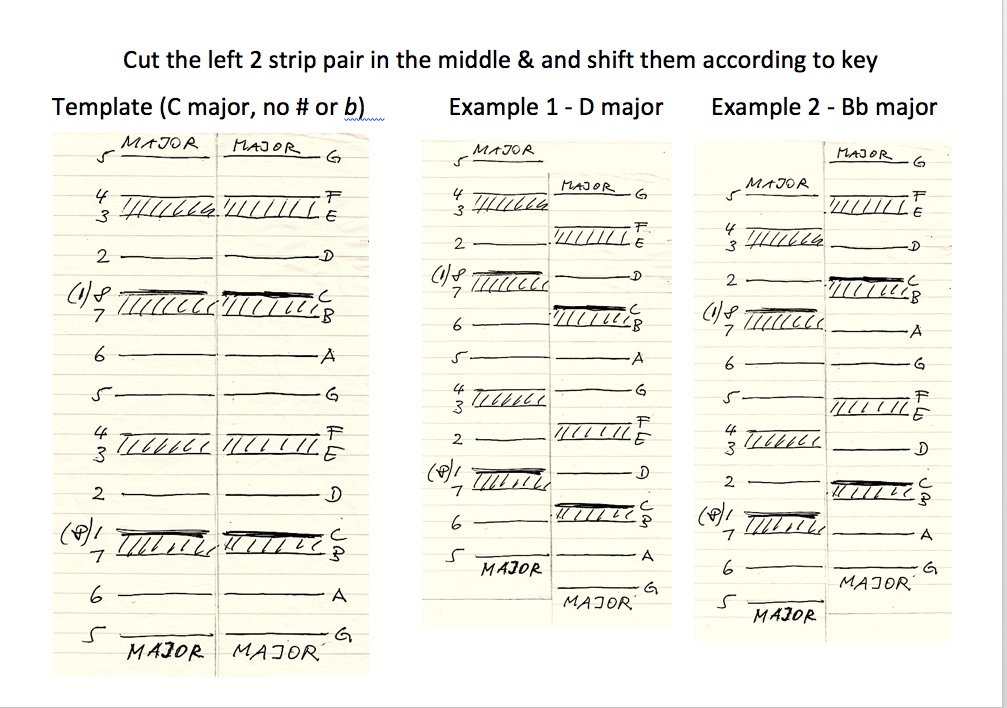
The 12 Major Scales according to finger patterns
FREE Download below
* Music Theory made very simple: Why is there which # and b?
Explained by using 2 simple moveable strips!
Click on image of the moveable strips to download, then cut vertically cut
My CELLO METHOD - VOLUME 3
- Half Position to 4th Position, Harmonics, Tuning & Vibrato -
$ 13.99 (will be send per email during the next 24 hours)
or instantly available from SMP (click icon)
Cello Issues: How to get a Good Sound
My CELLO METHOD - VOLUME 4
- Gems from the vast Repertoire of Cello Music
within the range of Positions 1 - 4 plus Tenor Clef
- pieces arranged as Cello Duos
$ 13.99 (will be send per email during the next 24 hours)
or instantly available from SMP (click icon)
For corresponding video lessons on Patreon
Watch all Cello Duos to My CELLO METHOD (forward to lower part of tracks)
No 100 - A. Noelck - Tempo di Ballo
No 101 - G.F Handel - Aria "Lascia Ch'io Pianga"
- good training for vibrato
No 102 - Introduction to the Tenor Clef 7 & 12/8 - slow and fast
No 103 - Vivaldi Largo (3rd mov) from Sonata E minor (tenor clef)
No 104 - D. D'alla Bella - Giga (tenor clef)
No 105 - S. Lee - Study opus 31 No 1
No 106 - R. Kreutzer - Study in G major
No 107 - J.B. Breval - Sonata C major, 1st mov.
No 108 - B. Romberg - Sonata op. 38 in E minor, 1st mov.
No 109 - J,S. Bach - Choral "Wachet auf!" (Eb maj)
No 110 - A. Vivaldi - Allegro (2nd mov) from Sonata E minor
No 111 - G. Marie - La Cinquantaine
No 112 - A. Vivaldi - Largo (1st mov) from Sonata E minor
No 113 - A. Vivaldi - Allegro (4th mov) from Sonata E minor
No 114 - F. Schubert - Ständchen (Romantic Serenade)
No 115 - J.S. Bach - Menuet I & II from Cello Solo Suite No 1 G major
(with added Duo part!)
No 116 - Introduction to J.S. Bach Prelude from Cello Solo Suite No 1
No 117 - J.S. Bach - Prelude from Cello Solo Suite No 1 (cello solo)
For corresponding video lessons on Patreon see below
Cello Duos to My CELLO METHOD (lower part of tracks)
My CELLO METHOD - VOLUME 4
- Gems from the vast Repertoire of Cello Music
within the range of Positions 1 - 4 plus Tenor Clef
$ 13.99 (will be send per email during the next 24 hours)
or instantly available from SMP (click icon)
(for private online lessons see bottom of page)
My CELLO METHOD - VOLUME 5
- Mastering Positions 5 to 7
(pieces arranged as Cello Duos)
$ 12.99 (will be send per email during the next 24 hours)
or instantly available from SMP (click icon)
* Corresponding Lessons and Duo Recordings soon!
No 118 - Exercise for Positions 1 - 7 on A string
No 119 - C major scale in 3 octaves
No 120 - Two Position Exercises for all strings by O. Sevcik
No 121 - S. Lee - Study No 5
No 122 - Catalan Trad. - Song of the Birds
No 123 - E. Galliard - Sarabande (E major)
No 124 - J.S. Bach - Bourree's of Cello Suite No 3 C major / minor
No 125 - J.S. Bach - Sarabande of Cello Suite No 5 C minor (solo)
No 126 - L.v. Beethoven - Sonatina
No 127 - F. Chopin - Largo from Cello Sonata
No 128 - P.I. Tchaikowsky - Valse sentimentale
No 129 - G. Mertens - Oriental
No 130 - C. Saint-Saens - The Swan
Watch The Swan" here for 2 cellos with an accompaniment
after Bach" Prelude in G major on Youtube
My CELLO METHOD - VOLUME 5
- Mastering Positions 5 to 7
(pieces arranged as Cello Duos)
$ 12.99 (will be send per email during the next 24 hours)
or instantly available from SMP (click icon)
My CELLO METHOD - VOLUME 6
- The higher Positions: Thumb Position & Treble clef / octave parallels
& artificial harmonics
(pieces arranged as Cello Duos)
$ 12.99 (will be send per email during the next 24 hours)
or instantly available from SMP (click icon)
No 131 - Thumb Position:
Scales in D & C major on harm A/D, E & D major on E/B, Frere Jacques
No 132 - F. Grutzmacher - Study 1, part 1(book 2)
No 133 - Japanese Trad. - Mokko
No 134 - C and D major in 4 octaves
No 135 - W.H. Squire - Tarantella
No 136 - M. Monn - Cello Concerto G minor as cello Duo according to Monn's manuscript
No 137 - G.M. & O. Sevcik - 2 Studies shifting octaves
No 138 - Octave parallels
No 139 - Artificial harmonics
No 140 - Frere Jacques in artificial Harmonics
No 141 - J. Duport - Study No 6 (Berteau)
No 142 - J. Haydn - Adagio from D major Concerto, Cadenza G.M.
No 143 - M. Bruch - Kol Nidrei
My CELLO METHOD - VOLUME 6
- The higher Positions: Thumb Position & Treble clef / octave parallels
& artificial harmonics
(pieces are arranged as Cello Duos)
$ 12.99 (will be send per email during the next 24 hours)
or instantly available from SMP (click icon)
As to my background:
I studied at the Musikhochschule Freiburg / Germany and hold a Diploma in teaching and performing cello (1976) and a diploma in teaching and performing Classical guitar (1978).
Teaching:
I wanted to be a cello teacher since I was 16 and have taught for more than 50 years. Publishing my CELLO METHOD was my first retirement project. I wish to make the over decades acquired specific knowledge available for future generations - analysing methods and the process of learning cello.
Performing:
I have performed more than 2000 times solo or Duo, Trio & Quartet, including more than 200 cello solo concerts over 16 years in the underground Cathedral Chamber at Jenolan Caves / Australia, the world's longest series of cello solo concerts! In 1992 I recorded the 6 Bach Cello Suites for 2 MBS FM Sydney, Britten Solo Suite No 2 plus many other programs for radio. I have recorded a LP (1983) plus 12 CD's.
My Youtube channel includes own compositions, arrangements, improvisations, the 6 Bach Solo Suites, Cello Duos and Duos for cello and guitar,
violin & guitar, viola da Gamba, cello & piano, piano Trio.
Online lessons via FB messenger, Facetime or zoom
please arrange a time beforehand -
either messenger on FB: georg.mertens.96
or email: georgcello@hotmail.com
45 min USD $75