The exceptional acoustic properties
of the Cathedral Chamber
We separate the main acoustic properties of a performance space into two categories:
firstly the basic noise level, the potential to provide total silence;
secondly the reaction of the space to the music performed, the quality of the echo.
In both the Cathedral Chamber is absolutely exceptional.
No car, plane or any artificial noise of our high tech environment enters this space, not even the sound of birds and wind. No signal for mobile phones penetrates the walls.
The cave is absolutely silent. The same massive rocks which shelter the inner cave of any outside noise provide the space with silent air conditioning keeping the temperature at 15 degrees for the last thousands of years, independent of seasons, independent of the outer world.
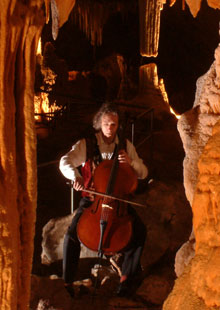
In a way we are transported back - just for an hour - into a much simpler and purer world sharing the mellow sounds of the cello or exciting Gypsy music. The concerts in the cave allow us to side step from our normal speedy, noisy and stressful environment.
As to the quality of the echo, no amplification is needed here; the large size of the hall with the hard rock surface amplifies the music so well and clear, we can hear in the last row as if the performers are sitting just next to us.
What is different to other large halls is, that
most have flat (stone) surfaces resulting in a clearly defined echo, which interferes with the clarity of the sound.
In many Cathedrals
a note may linger for 8 - 15 seconds. This note will interfere with the notes following. Gothic churches supply us with an echo like this; you can virtually feel the largeness of the hall, but any fast passage turns into a blur.
Studios are therefore equipped with a wall surface deadening the sound. It reassures clarity - echo and reverb are added artifically.
But here the Cathedral Chamber is exceptional: the surface is naturally uneven, many side caverns are going off, no flat surface can reflect a clear image - instead all sounds are naturally diffused. The sounds spread irregularly in all directions and give us a natural warmth.
The echo of the Cathedral Chamber is very strong and very short - about 1.5 seconds - then we have silence again. A unique hall, silent in seclusion, amplifying the music strong and rich - and also clear and pure; like an accidental natural wonder suiting music performance.
Particularly in the Cello Concert you can hear several compositions - newly composed or transcribed - especially using the potential of the acoustics of the Cathedral Chamber.
A bit of History
The Cathedral Chamber is with 54m (163 feet) the highest and biggest cavern of the Lucas cave, a soaring and awe inspiring place carved into the limestone, deep underground. The name "Cathedral" derives not only from natural limestone features like "the cathedral windows" - reminding of a European Gothic cathedral - or "the pulpit" - looking like an ancient Romanesc pulpit - but also from the fact, that this chamber was actually an official place of church services of the Presbyterian Church for more than fifty years.
The "Cathedral" (Chamber) became quickly known for its superb acoustics. World famous performers like Dame Nelly Melba, Joan Sutherland and the Vienna Boys Choir were attracted to perform here, at a time where a trip to this place in the country was a huge and cumbersome effort.
Joan Sutherland called it "the hall with the best acoustics I ever sang in". Recently world renowned audio manufacturers selected the Chamber to test their microphones.
But it took to 1999 that concerts in the Cathedral Chamber became a regular event. After two series of 4 cello concerts in 1997 and 1998 Georg Mertens put the vision forward that regular concerts in this exceptional place could become a draw cart for visitors from Australia and overseas. Since then several thousand visitors have enjoyed the monthly cello and Gypsy music concerts on Saturday afternoons.
_________________________________________________________________
The old age of the Caves
Jenolan Caves 340 million years old: study
Cave-dating research published by Australian geologists has found that the Jenolan Caves, in central NSW, are the world's oldest discovered open caves.
In a study published in the June issue of the Australian Journal of Earth Sciences (Vol. 53, 377-405), scientists from CSIRO, the University of Sydney and the Australian Museum - in cooperation with the Jenolan Caves Trust - have shown that the limestone caves, which attract thousands of tourists each year, date back more than 340 million years.
Until 20 years ago most scientists thought the Jenolan Caves were no more than a few thousand years old. In 1999 geologists estimated that the caves might be between 90 and100 million years old.
Dr Armstrong Osborne, a senior lecturer at the University of Sydney, has long suspected that the caves are older than had been widely recognised, but says he was surprised to find they dated back to the Carboniferous (290 to 354 million years ago).
"We've shown that these caves are hundreds of millions of years older than any reported date for an open cave anywhere in the world," Dr Osborne says.
"Even in geological terms, 340 million years is a very long time. To put it into context, the Blue Mountains began to form 100 million years ago; dinosaurs became extinct 65 million years ago, and Tasmania was joined to the mainland as recently as 10,000 years ago.
"Most people were convinced that caves were quite young, and those of us who thought they were really old couldn't find any evidence. But no one imagined that they would be more than 300 million years old. This was totally off the planet."
The study used clay-dating methods that CSIRO's Petroleum Resources division developed to help oil exploration companies find oil deposits. The technique is a variation of conventional potassium-argon dating, which can calculate the age of minerals by measuring levels of decay caused by radioactive potassium.
CSIRO Petroleum Resources researcher Dr Horst Zwingmann says the age of the caves was determined by dating the clay minerals that crystallised when volcanic ash entered the caves, and which now forms much of the mud in the Temple of Baal and Orient caves.
"We were able to provide evidence that the clays did form in-situ in the caves and that the sections regularly visited by tourists actually formed in the Carboniferous," Dr Zwingmann says.
"This study shows how industry-focused research techniques can also be used to solve more general geological mysteries."
The Australian Museum carried out initial studies using X-ray diffraction and scanning electron microscope imaging to identify clay minerals and their properties to see if they were suitable for dating.
Images are available from CSIRO Media Liaison - Ph: 02 6276 6406.